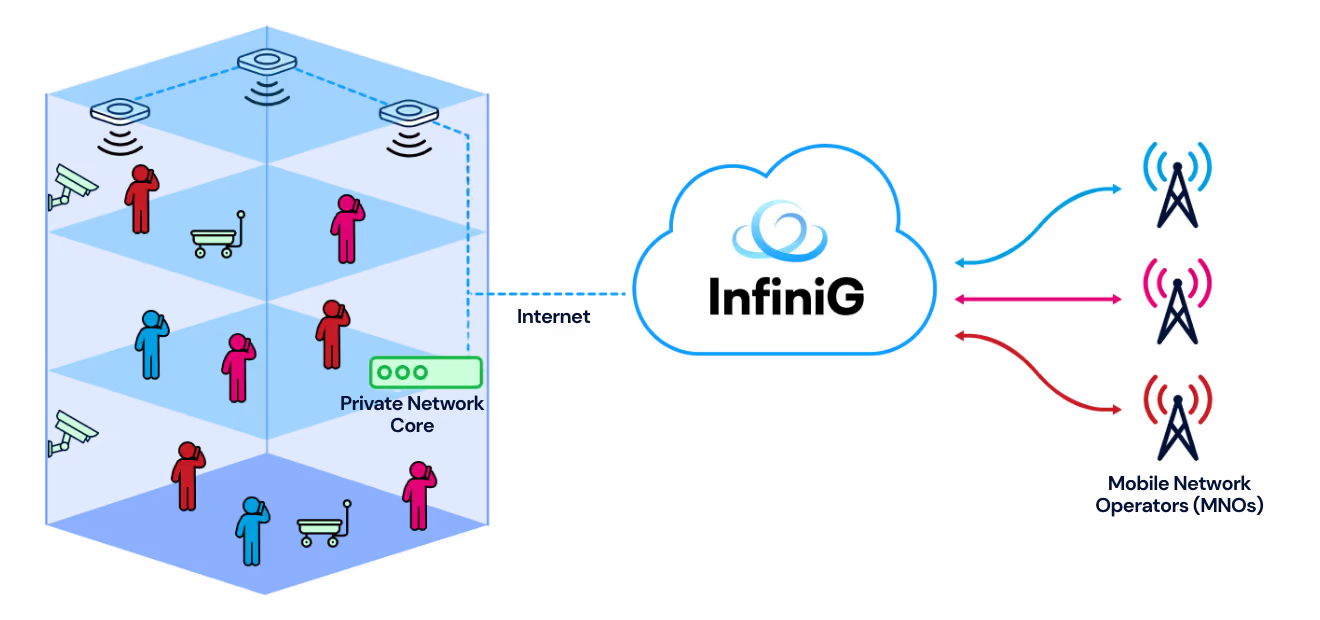
MCaaS (Mobile Coverage as a Service™) extends public cellular service using small radio nodes that share CBRS airwaves, LAN infrastructure, and the building’s existing broadband service to connect each mobile user to their mobile network operator.

MCaaS is very similar to traditional WiFi and IT infrastructure, where radio nodes connect to PoE switches with Category 5/6 cable, and switches connect to each other via fiber cable. The solution shares the router/firewall and Internet connection from the building.

MCaaS offers enterprises the option to "bring your own private network" and run it on the same infrastructure that you’ve already invested in. InfiniG often partners with private network providers to deliver important private network applications.


A Spectrum Access System is a cloud-based service that coordinates the use of CBRS spectrum. It authorizes frequencies and power levels for each CBRS radio, protects higher-priority users, and can adjust assignments when local spectrum conditions change. The SAS framework was developed through coordination among industry, the FCC, and the Department of Defense to make CBRS available for commercial use while protecting federal operations.
CBRS is known as the Innovation Band because it introduced a shared-spectrum model that lets organizations deploy cellular networks without buying nationwide licenses. Automated spectrum coordination and widely available 4G and 5G technology opened cellular infrastructure to enterprises, schools, hospitals, manufacturers, venues, and new service providers.
CBRS is shared spectrum, but it is not unmanaged like conventional unlicensed Wi-Fi spectrum. Every CBRS radio must receive an active authorization, or grant, from an FCC-certified Spectrum Access System (SAS), which assigns channels and power levels while protecting higher-priority users. General Authorized Access (GAA) does not provide an individual spectrum license, but SAS coordination allows multiple local users to share available spectrum in a controlled way. InfiniG combines that coordination with professional RF design, capacity planning, continuous monitoring, and ongoing optimization to deliver dependable enterprise service.
Yes, CBRS provides substantial capacity for most properly designed indoor enterprise deployments. In many indoor locations, most or all of the 150 MHz band may be available, although the SAS determines actual channel availability. Network capacity also depends on building size, radio placement, user density, and traffic patterns. InfiniG sizes radios and backhaul for the site; CBRS neutral host is not positioned as a universal replacement for every extremely high-density licensed-spectrum venue.
For most indoor enterprise deployments, General Authorized Access (GAA) is sufficient. The SAS coordinates available channels and power, and the building commonly provides meaningful RF isolation from nearby CBRS users. Airports, stadiums, dense outdoor campuses, highly congested locations, or critical applications may consider a Priority Access License (PAL) for additional predictability and interference protection.
Low-band spectrum generally travels farther and penetrates buildings better but offers less capacity. Mid-band balances coverage and capacity. High-band spectrum, including millimeter wave, can deliver very high capacity over shorter distances. CBRS at 3.5 GHz is mid-band spectrum and is well suited to carefully designed indoor networks.
CBRS at 3.5 GHz offers a practical balance of indoor coverage and capacity. Building materials attenuate the signal, helping contain coverage and limit interaction with surrounding networks when the system is properly designed. InfiniG combines that natural isolation with RF planning, power control, and SAS coordination.
No current evidence suggests that enterprises should plan for CBRS to disappear. CBRS is an established FCC service with a substantial installed ecosystem across enterprise, fixed wireless, industrial, education, transportation, and hospitality deployments. No spectrum framework is literally permanent, but changing CBRS now would be highly disruptive and costly.
Interference is a manageable RF-design consideration, not a reason to avoid CBRS. The SAS coordinates channel and power assignments, while InfiniG uses RF planning, site validation, monitoring, and optimization to manage the local radio environment. If conditions change, the network can be reconfigured.
An indoor CBRS network normally does not create co-channel interference with an operator's licensed macro bands because it uses different spectrum. Coverage boundaries and mobility settings still must be engineered so devices transition cleanly between indoor and outdoor networks. If an operator also uses CBRS nearby, SAS coordination and RF design help manage the shared band. This is substantially less complex than a typical deployment using mobile-operator spectrum, which must be coordinated individually and on an ongoing basis by each operator.
Yes, MCaaS can often use an existing business-class internet connection when it meets the required bandwidth, latency, reliability, security, and availability standards. A dedicated or secondary connection may be recommended for larger sites, critical operations, stronger service-level objectives, or network resiliency.
InfiniG MCaaS establishes encrypted, secure connections across the internet circuit to participating mobile operators. The security of the cellular traffic and operator connection does not depend on treating the public internet as trusted. InfiniG also evaluates and monitors bandwidth, latency, jitter, packet loss, and availability; where the existing circuit cannot meet service requirements, InfiniG may recommend traffic prioritization, additional capacity, failover, or a dedicated connection.
There is no single bandwidth requirement for every building. InfiniG sizes backhaul based on the number of radios, expected concurrent users, traffic profile, service requirements, and growth headroom. The design also considers latency, jitter, packet loss, reliability, and failover - not only the advertised upload or download speed.
InfiniG resale partners coordinate with the enterprise customer or an approved installation contractor to install the MCaaS network. The partner and installer handle cabling, equipment placement, power, and construction coordination, while InfiniG provides design requirements, configuration, operator integration, commissioning, and service validation.
InfiniG MCaaS combines the CBRS radio-access network (RAN), required software and licenses, SAS coordination, mobile-operator onboarding, remote monitoring, performance management, support, and lifecycle operations. InfiniG then manages the network on an ongoing basis to help ensure proper performance for all parties. Site surveys, cabling, installation, internet connectivity, backup power, and other site-specific infrastructure are included or separately scoped through the delivery partner, depending on the proposal.
InfiniG focuses primarily on indoor cellular coverage, where the building creates a natural RF boundary. Outdoor coverage is typically left to the mobile operators' macro networks. When a customer also requires coverage between buildings or elsewhere across a campus or large property, InfiniG can evaluate a site-specific outdoor extension based on the coverage objective, operator requirements, RF environment, and available CBRS spectrum.
Technically, yes, but partial-building coverage is generally not preferred. Mobile operators typically want the entire building covered so users receive a consistent experience and reliable access to emergency calling throughout the property. InfiniG evaluates the building, existing coverage, occupancy, and safety requirements before recommending the appropriate scope.
Technically, yes, but temporary events are generally not the best fit for MCaaS. Each participating mobile operator must complete network integration, configuration, testing, and approval, which can require significant effort relative to a short-duration deployment. InfiniG evaluates temporary requirements case by case, including the event timeline, location, desired operators, and available alternatives.
MCaaS scales through a repeatable architecture, standardized building designs, centralized monitoring, and a common operating and management model. Enterprises can start with priority buildings, create templates by building type, and roll out in phases while viewing performance across the portfolio. Each site is still validated for local RF requirements, user demand, and backhaul.
Adding another participating mobile operator is relatively simple and coordinated by InfiniG. The shared RAN is designed for multiple operators; after the operator approves and configures the site, InfiniG can activate service through the existing platform, subject to capacity, backhaul, and operator-specific requirements.
No. InfiniG handles mobile-operator participation through its operator contracts and onboarding processes, simplifying the experience for the enterprise and delivery partner. Each operator must still authorize and activate service, but the enterprise does not need to negotiate and manage a separate deployment agreement with every operator.