
"The system just went live after installation. Phones just worked. 911 calls went through to the PSAP."
Jason Eyre

At Parkside Elementary, getting enough cellular signal to make an emergency call could mean leaving the school. Before InfiniG, the principal had to go outside and across the park to place a mobile 911 call, stepping away from students and staff at the moment they needed school leadership most.
For Murray City School District, reliable indoor cellular coverage was an essential part of keeping people connected inside the school.
An emergency call shouldn’t require leaving the school
Parkside’s location and construction made it difficult for outdoor cellular signals to reach the people inside. The school sits in a canyon-like area, and its metal roof further weakens the signal. Phones could show limited service, struggle to complete calls, or fall into SOS mode.
Those gaps affected everyday staff coordination as well as access to emergency services. A phone that only worked after someone left the building could not meet the school’s communications needs.
The district already had a Wi-Fi network engineered for high-density classroom traffic. Its remaining requirement was a dedicated cellular layer that let people use their normal carrier service for calling, texting, and data, including mobile 911 calls, without an app or Wi-Fi sign-in.
The goal was straightforward: bring cellular coverage inside so staff could communicate from where they were needed.
Bringing AT&T and T-Mobile coverage inside in days
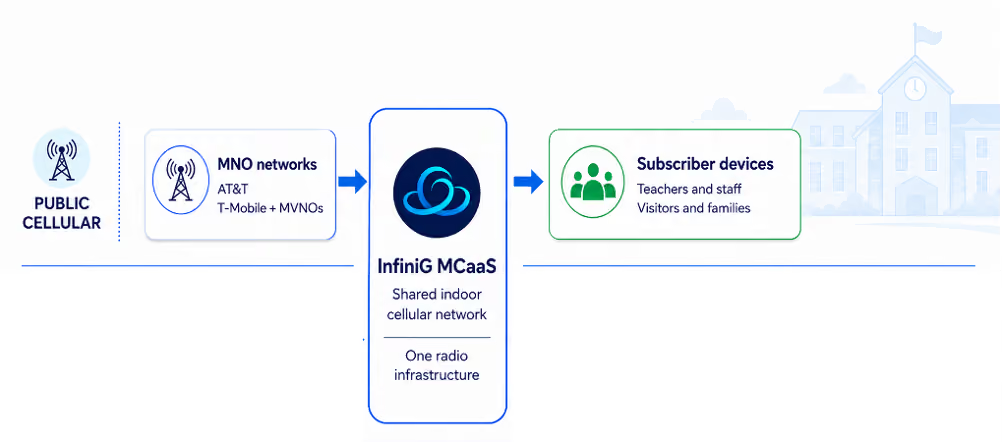
InfiniG deployed its Mobile Coverage as a Service (MCaaS) Neutral Host platform at Parkside. Indoor cellular radios connected the school to participating mobile operators through one shared system.
Installation took approximately three to four days, with minimal disruption to the school. InfiniG handled coordination with the participating operators and operates the indoor network as a managed service.
AT&T and T-Mobile joined the Parkside network, bringing strong indoor coverage to their subscribers and customers of MVNOs that use those networks. People could continue using their phones through their existing carrier service without changing their everyday habits.
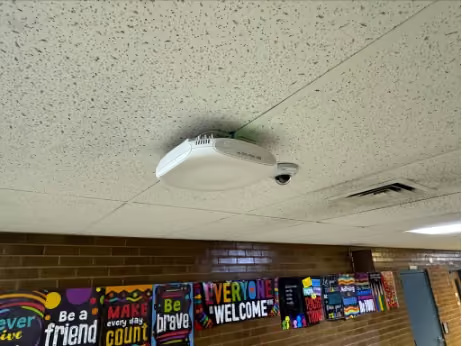
The shared infrastructure supports multiple mobile network operators, and each operator is invited to participate. As of August 2026, Verizon had not joined Parkside’s Neutral Host network, and its subscribers continued to experience limited indoor coverage.
Staff can stay connected where they’re needed
- Strong indoor coverage for AT&T and T-Mobile subscribers and customers of MVNOs using those networks.
- Mobile 911 calling inside the building for participating carriers.
- Easier day-to-day staff coordination without leaving the school to find a signal.
- Native calling, texting, and data without an app or Wi-Fi sign-in.
- Installation completed in approximately three to four days with minimal disruption.
InfiniG handled the carriers and the network
Murray City School District brought a clear requirement: reliable indoor cellular service that supported staff communications and emergency access without adding a mobile network to the district’s operational responsibilities.
InfiniG provided the indoor cellular platform, coordinated participating operators, and managed the shared system. The district did not have to pursue and integrate each carrier independently.
“InfiniG simplified the deployment. We didn’t need to work with each of the carriers at all.”
—Jason Eyre, Technology Coordinator, Murray City School District
That service model helped Parkside move from a difficult coverage problem to an operational indoor network. The district gained cellular service for participating subscribers while InfiniG handled the network and carrier coordination behind it.
A foundation for the district’s next connectivity needs
At a school, the practical value of cellular coverage is the ability to communicate where people need help. Staff should be able to coordinate with colleagues or place an emergency call while remaining close to students and the situation they are managing.
Parkside’s deployment brought that capability inside. For participating carriers, mobile 911 calling became available within the building, and Jason Eyre reported that calls reached the Public Safety Answering Point, or PSAP.
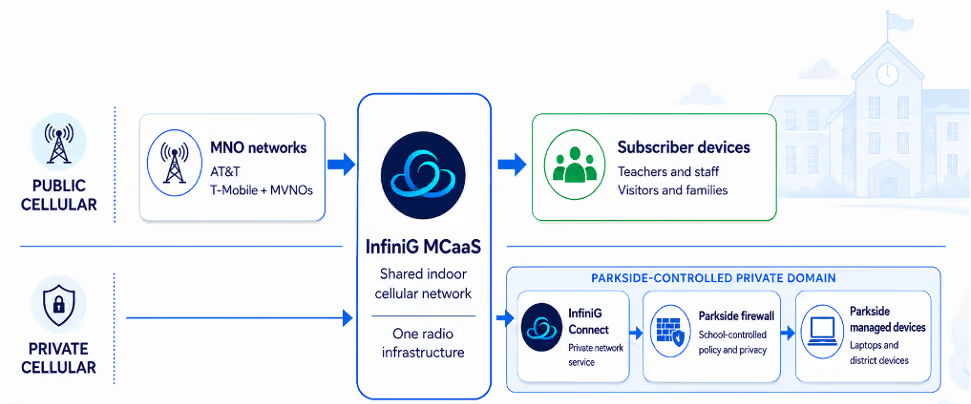
The same indoor infrastructure also creates a path for future district-controlled connectivity. Through the optional InfiniG Connect service, the district can add a private cellular network for authorized devices such as laptops, Chromebooks, and cameras.
That private network can use the radios already installed for MCaaS, with district-defined policies and traffic kept behind the school firewall. It gives the school a way to add dedicated cellular connections for managed devices without competing for Wi-Fi airtime.
Parkside shows how a district can address an immediate indoor coverage need through a managed service while retaining room to expand. The first priority is practical: help staff stay connected inside the school, including when they need to reach emergency services.